Ignition waveform tester UK: primary vs secondary checks for garages
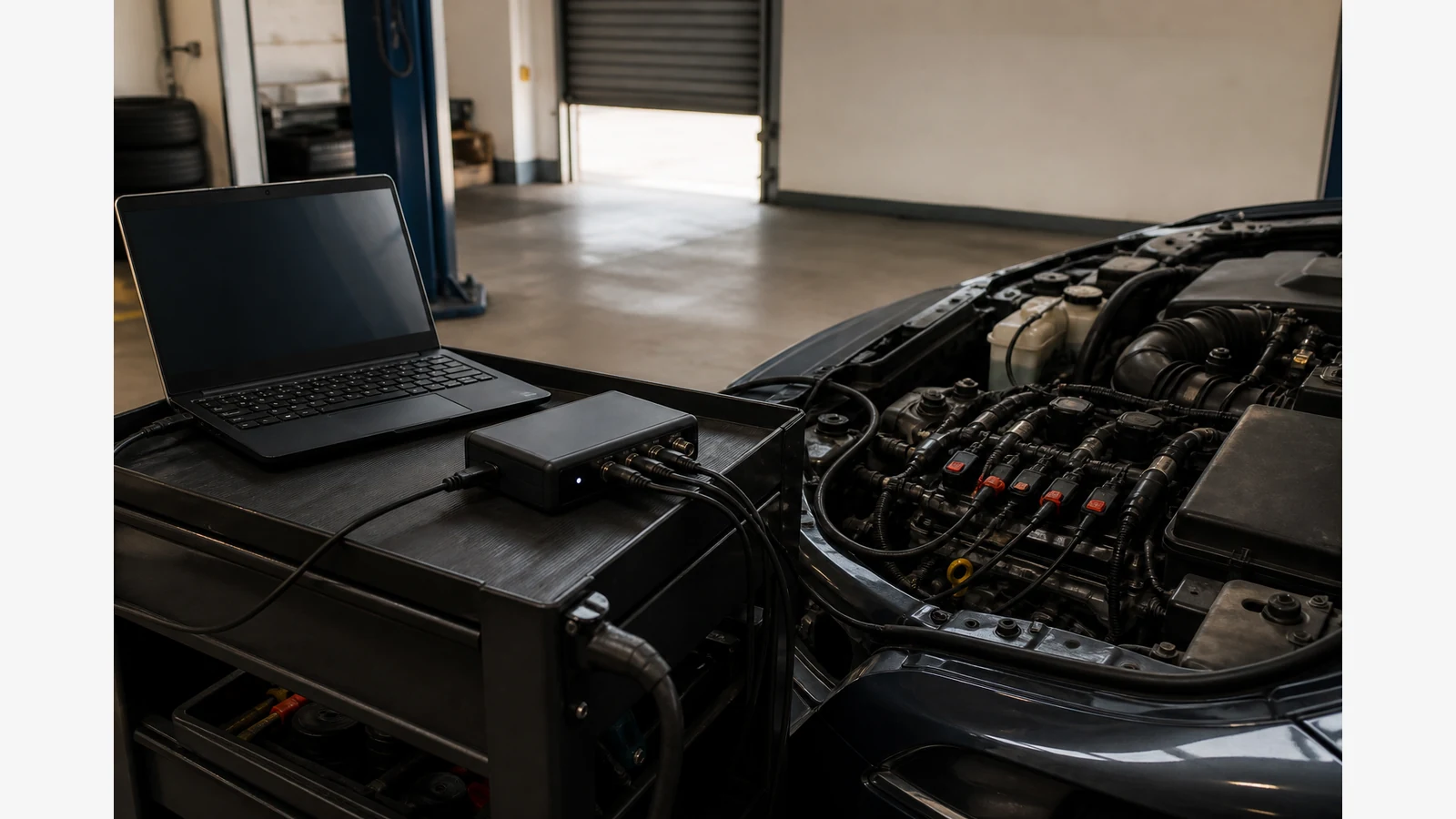
An ignition waveform tester, in UK garage practice, is usually an automotive oscilloscope plus a suitable probe method: it shows coil control voltage, coil current and (where safely accessible) secondary behaviour that a code reader cannot prove. Scan tools report misfire counts and readiness; a scope capture shows whether the primary circuit is switching, whether current ramps cleanly, and whether cylinders match under idle and load.
Independent workshops still meet intermittent misfires and coil-on-plug (COP) jobs where freeze-frame data stalls the bay. UK trade coverage has long treated oscilloscope ignition capture as a core diagnostic method for primary and secondary systems, not a novelty add-on. Beginner automotive scope guidance also lists ignition primary voltage and current among the highest-leverage early waveform tests.
What a scope shows that a code reader cannot
A code reader may log cylinder contribution or misfire history, but it rarely proves whether the ECU drive, coil primary, or secondary path is at fault. Primary coil control voltage and current waveforms are used in UK technical training to confirm ignition circuit faults before parts are swapped. That comparison across cylinders is what turns a vague P030x family complaint into a workshop decision.
UK garage checklist for safe ignition captures
- Stable bench first. Use a reliable laptop or PC trolley, known-good USB lead, and a clear ground strategy before any high-voltage work.
- Probe choice. Prefer manufacturer-approved primary back-probes or inductive pickups rated for the job. Secondary ignition probing can be hazardous; keep methods high-level, follow probe instructions, and never improvise with unrated leads.
- Ground and reference. Confirm a solid chassis or battery negative reference so noise does not masquerade as a coil fault.
- Idle, then loaded. Capture at idle, then under a controlled load (road or dyno as available) so intermittent dropouts appear.
- Compare cylinders. Overlay or tile channels; look for missing dwell, clipped current ramps, or one coil that diverges from its neighbours.
- Label and save. Store named captures with vehicle, date, and cylinder IDs for reference on the next similar job.
Primary vs secondary: what each channel answers
- Primary voltage: Did the control circuit switch as commanded?
- Primary current: Did the coil magnetise normally, or is there an open, short, or weak ramp?
- Secondary (when appropriate equipment and training allow): Burn time and firing line shape can hint at plug, boot, or coil secondary issues — without inventing kilovolt “pass” numbers.
Multi-channel captures help when you need simultaneous views of several COP units or primary plus a sync reference. An 8-channel USB automotive oscilloscope is only worth reviewing after you know your first three ignition jobs need simultaneous captures; many shops start effectively with fewer channels plus disciplined sequential testing.
Who should not buy yet
Hold off on expanding ignition scope tooling if you lack a stable laptop bench, or if your classic-car work only needs a timing light. Also pause if you are not prepared to treat secondary probing as a safety-critical skill with correct accessories.
Next decision for the workshop
Map your next three ignition jobs to the channels and accessories you already own. If simultaneous multi-coil captures keep blocking progress, review a multi-channel USB automotive scope and pair it with a clear accessory plan — see our automotive lab scope accessories checklist and, when you need product context, the 8-channel automotive oscilloscope detail page. Related reading: fuel injector waveform oscilloscope UK and USB automotive oscilloscope buyer’s guide.